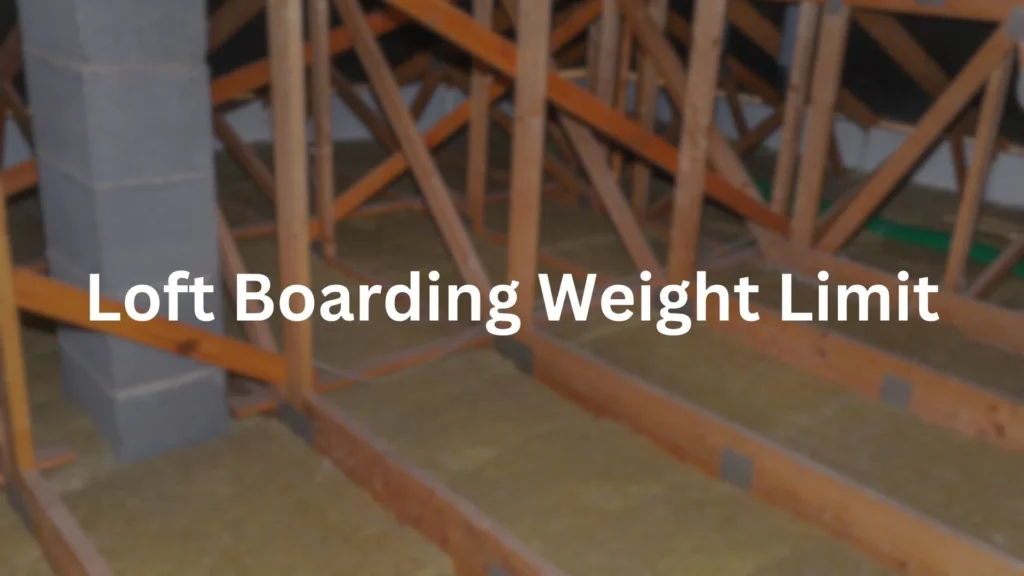
The weight a boarded loft can hold is set by the ceiling joists underneath, not by the boards on top. As a commonly cited rule of thumb, most UK lofts are suited to light to medium storage of around 25kg per square metre, spread evenly. That is a general guideline rather than a guarantee, because the real limit depends on your joist size, span, spacing and condition.
This guide explains how loft weight limits work, how to estimate the load in your own loft with a worked example, and which items are best left out of the roof space. At Fife Premier Handyman Services, we board lofts across Fife, and the weight question is one of the most common things homeowners ask before we start.
If you’d like it done for you, see our loft ladders and loft boarding in Fife.
The Short Answer
Here are the key points in plain terms:
- Boards are not the limiting factor. Standard loft boards can take far more than the structure beneath them
- Joists carry the load. Ceiling joists in many homes were designed to support the ceiling below, not heavy storage
- A common guideline is around 25kg per square metre, spread evenly across the boarded area
- Spread matters as much as total weight. A heavy item in one spot is far riskier than the same weight spread out
- Raised boarding systems do not add strength. They protect insulation, but the weight still travels to the same joists
- If in doubt, get the joists checked before storing anything heavy
Why the Boards Are Not the Limit
Loft boards, usually chipboard around 18mm to 22mm thick, are designed to span the gap between joists and give you a flat surface. They can usually cope with far more than the joists below can safely carry.
The joists are the part doing the real work. They are the timber beams running across the top of your ceiling, and every kilogram you store ends up resting on them. If the joists are small, widely spaced or in poor condition, the loft can only take a modest load, however sturdy the boarding looks.
This is also true of raised loft boarding systems. The supporting frame sits above the insulation and passes weight down through its legs onto the joists. It helps you board without squashing insulation, but it does not make the joists any stronger.
What Decides Your Loft’s Capacity
Several factors work together to determine how much your loft can carry:
- Joist size, since deeper joists carry more than shallow ones
- Joist span, because longer unsupported spans carry less
- Joist spacing, as joists set closer together share the load better
- Timber condition, since rot, woodworm or damp can weaken even large joists
- Alterations, such as notches, drilled holes or cut sections for pipes and cables
- The roof type, which affects how the structure is built and supported
- Where the weight sits, since load near a supporting wall is gentler than load at the middle of a span
Traditional Roofs and Trussed Roofs
Older homes often have a traditional cut timber roof, where the ceiling joists may be supported at several points by internal walls. Many newer homes have a trussed rafter roof, where factory made triangular frames carry the roof and the bottom of each truss also acts as the ceiling joist.
In a trussed roof, the timbers are typically fairly slim and are engineered for a specific job. They should never be cut, notched or altered to make room for storage, and heavy loads should be avoided unless a professional has confirmed the structure can take them.
Typical Weight Guidance
The table below summarises how loading generally breaks down. These are rough guidelines to help you think about your loft, not a structural calculation.
| Loading level | Approx. weight per m² | Typical examples |
| Light storage | Up to around 15kg | Empty suitcases, bedding, decorations, light boxes |
| General guideline maximum | Around 25kg | Mixed household storage, spread evenly |
| Above guideline | More than 25kg | Heavy books, tools, equipment. Get joists checked first |
Spread Load vs Point Load
A spread load is weight distributed over a wide area, such as a dozen light boxes laid across several square metres. A point load is weight concentrated in one place, such as a stack of boxes of books in one corner.
The 25kg per square metre guideline assumes a spread load. If you put 100kg on a single square metre, you have loaded that spot at four times the guideline, even if the total weight across the loft is modest.
Worked Example: Estimating Your Loft Load
Here is a simple way to estimate whether your storage plans are sensible.
- Measure the boarded area. Multiply length by width. For example, 3m by 4m gives 12 square metres
- Apply the guideline. 12m² multiplied by 25kg gives roughly 300kg as a general maximum across the whole area
- List what you plan to store and estimate each item’s weight, ideally by weighing boxes on bathroom scales
- Add it up and compare it with your guideline figure
- Check how it will be spread, not just the total
Here is an illustrative example of a typical household load:
| Item | Quantity | Approx. total weight |
| Boxes of Christmas decorations | 3 | 18kg |
| Suitcases holding spare bedding | 2 | 14kg |
| Boxes of books | 4 | 72kg |
| Camping gear | 1 set | 25kg |
| Spare duvets and pillows | Several | 10kg |
| Total | All items | 139kg |
Across 12 square metres, that is an average of about 11.6kg per square metre, which sits comfortably within the guideline.
Now change the picture. If those four boxes of books, at 72kg, are stacked together in one corner covering around half a square metre, that spot is loaded at well over 140kg per square metre. The total is the same, but the loading is far more demanding on those few joists. Splitting the books into smaller boxes and spacing them out, or keeping them elsewhere in the house, solves the problem easily.
A Typical Job Scenario
This is an illustrative scenario based on a common situation, not a specific customer job.
A homeowner in a 1960s semi wants to board the loft to store boxes of books, an old hi-fi, camping gear and spare bedding. The loft has standard softwood joists with moderate spacing and a water tank sitting in one corner. On inspection, the timbers look sound, there are no signs of damp, and there are no obvious notches or cuts.
The sensible recommendation in a case like this is usually:
- Use raised boarding over the main storage area to protect the insulation
- Store the lightest items in the middle of the loft and keep heavier items nearer the edges, close to the supporting walls
- Keep the books in smaller, lighter boxes rather than a few heavy ones
- Leave the old hi-fi and other heavy equipment downstairs or in a garage
- Keep a clear walkway so the boards are not overloaded in one place
That gives the homeowner useful storage while keeping the loading well within sensible limits.
Items Best Kept Out of the Loft
Some items are poor choices for loft storage, either because they are heavy or because the loft environment is bad for them.
- Heavy books and filing boxes, which pack a lot of weight into a small footprint
- Tools, paint tins and building materials, which are dense and awkward to move
- Old appliances and large electronics, which are heavy and can be damaged by temperature swings
- Gas bottles, fuel, paint thinners and other flammable items, which should never be stored in a loft
- Photos, documents and keepsakes you care about, since lofts can swing between hot and cold and may suffer condensation
Warning Signs of Overloading
If you already have a boarded loft, watch for signs that the load may be too much:
- New cracks in the ceiling plaster below
- A ceiling that looks like it is sagging or dipping
- Visible bowing in the joists when you look at them
- Creaking or noticeable movement when you walk on the boards
- Nails or screws working loose in the ceiling below
If you see any of these, remove the heaviest items and have the loft looked at by a professional before loading it again.
When to Get Your Joists Assessed
A quick look in person can answer in minutes what is hard to judge from the ground. It is worth having your joists assessed before boarding if:
- You live in an older home where the timber size and condition are unknown
- You can see slim or widely spaced joists
- There are notches, drilled holes or cut sections from earlier pipe or cable work
- You notice rot, woodworm or damp in the roof space
- You plan to store heavy items, or want to use the loft for something beyond light storage
- Your home has a trussed roof and you want to be sure of what can be done safely
Fife Premier Handyman Services can check your joists and loft before boarding, advise on whether basic or raised boarding suits your home, and tell you honestly if the structure looks like it needs a specialist opinion. Where structural calculations or strengthening are needed, that is a job for a structural engineer, and we will say so rather than guess. It is also worth checking with your local authority building standards team if you are planning anything beyond simple storage boarding.
How to Spread the Load Safely
Even within sensible limits, a few habits make a boarded loft safer and longer lasting:
- Spread items across the boarded area instead of stacking them in one place
- Keep heavier items nearer the edges, close to supporting walls, and lighter items in the middle
- Use several smaller boxes rather than a few very heavy ones
- Check the load rating of any raised boarding system and follow the manufacturer’s guidance
- Leave a clear walkway, so you are not stepping over and around stacked boxes
- Do not board more than you need, since partial boarding limits how much weight you can add
Frequently Asked Questions
How much weight can a loft floor hold per square metre?
A commonly cited guideline is around 25kg per square metre, spread evenly. This is a general rule of thumb. Your actual limit depends on joist size, span, spacing and condition, so it is worth having them checked if you plan to store anything heavy.
Can loft boarding hold a person’s weight?
Boarding can support a person walking carefully over it, as long as the joists beneath are sound. It is not designed for heavy, repeated loads. If you plan to spend a lot of time in the loft, for example working or moving heavy items, get the structure checked first.
Does raised loft boarding hold more weight than standard boarding?
No. A raised system keeps your insulation at full thickness, but it still passes the load down to the same joists. It does not make the structure stronger, so the same weight guidance applies.
Can I store heavy items in a boarded loft?
It is best avoided unless the joists have been assessed. Heavy items such as stacks of books, tools or old appliances are better kept elsewhere. If you do need to store something heavy, place it near supporting walls and speak to a professional first.
Will loft boarding damage my ceiling?
Boarding itself should not damage a ceiling if the load is sensible and well spread. Overloading can cause cracks or sagging in the ceiling below, which is why spreading the weight and avoiding heavy point loads matters.
Do I need approval to board a loft?
Simple storage boarding does not usually need formal approval, but this can depend on what you are doing and where you live. If you are changing the structure or planning more than storage, check with your local authority building standards team before you start.
Does insulation affect how much weight a loft can hold?
Insulation does not add strength. Its job is to keep heat in. What matters for weight is the joists, which is why a raised boarding system is used to protect insulation without pretending to increase load capacity.
Final Thoughts
Loft boarding is only as strong as the joists beneath it, so the best approach is to store light to medium items, spread them across the boarded area and keep heavy objects out of the loft. A general guideline of around 25kg per square metre is a helpful starting point, and a quick worked estimate of your own load will show whether your plans are sensible. If you are in an older home, have slim joists, or want to store anything heavy, a quick check before boarding is the safest way to avoid problems with your ceiling or your insulation. Done sensibly, a boarded loft can give you years of reliable storage without putting your home at risk.