
Decking Installers in Fife
A well-built deck gives you usable garden space for most of the year, even with Scottish weather. We design and build timber and composite decking across Fife, for gardens in Kelty, Dunfermline, Cowdenbeath, Lochgelly, Kirkcaldy, Glenrothes, Inverkeithing, Rosyth, Kinross and the villages in between.
Timber and Composite Decking Built for Scottish Weather
The part of a deck you don’t see matters most. We start with a properly levelled frame on solid footings, use treated joists at the right spacing, and leave drainage and airflow underneath so the deck doesn’t rot or sag after a few wet winters.
On top, you can choose pressure-treated softwood, hardwood or low-maintenance composite boards. Timber is warmer and cheaper to start with; composite costs more upfront but needs far less upkeep and won’t splinter. We’ll talk through both honestly.
We build ground-level decks, raised decks on sloping gardens, steps, balustrades, and decks that wrap around hot tubs, garden rooms and saunas.
Want to read more first? See our guide to choosing decking that can handle Scottish weather.
A Deck Built to Last, Not Just to Look Good
Most decking problems come from rushed frames: joists too far apart, no fall for water, timber sitting in wet ground. We build every deck as if it’s for our own garden, with fixings and materials chosen for the Scottish climate.
You’ll get a clear written quote with the board type, frame and any steps or rails itemised, so you can compare like for like.
Which Decking Is Right for Your Garden
Most customers want either a simple, good-value timber deck for the family, or a low-maintenance composite deck that will look the same in ten years.
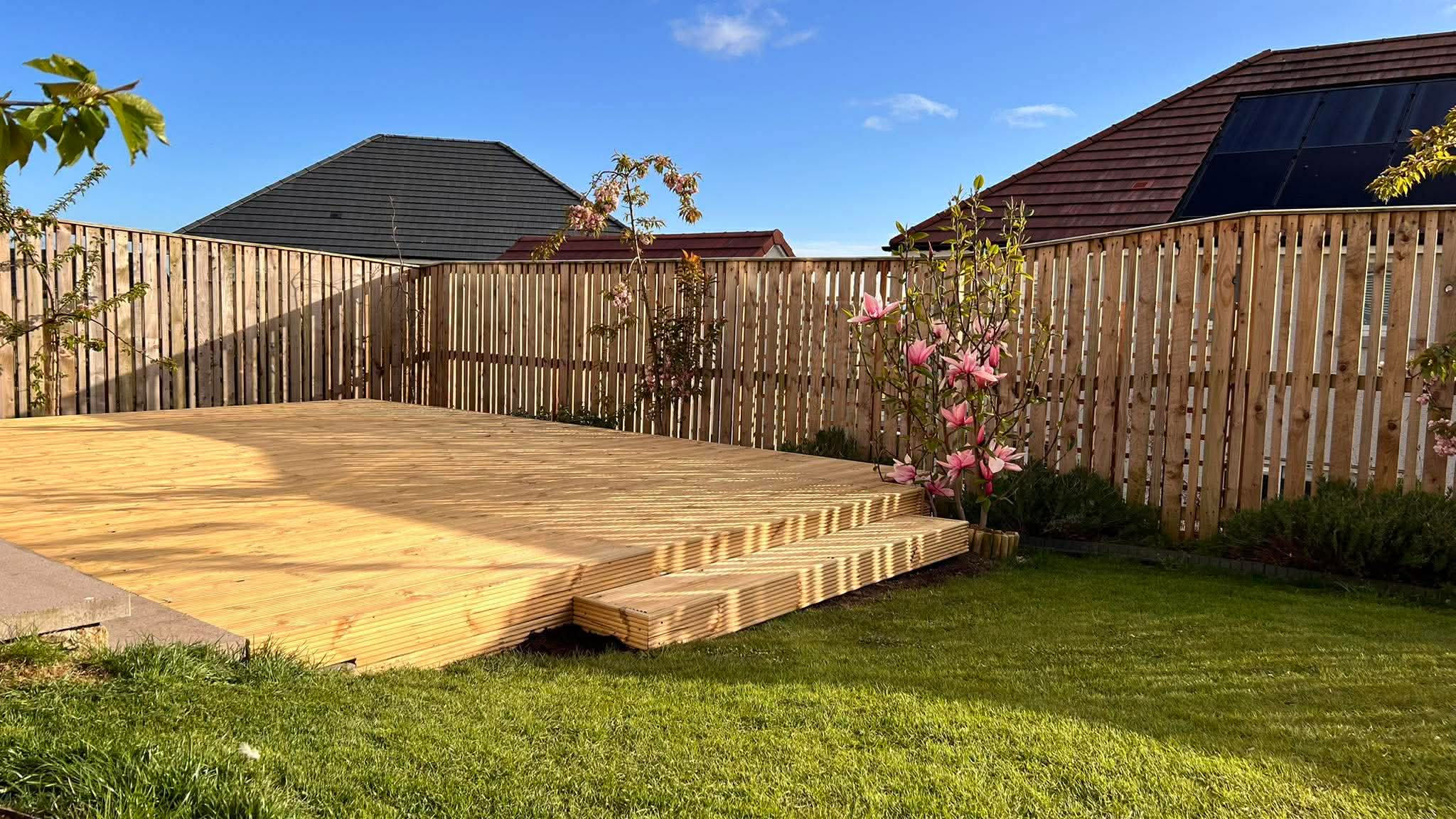
Timber Decking
Pressure-treated softwood or hardwood boards, warm underfoot and good value, with occasional cleaning and oiling to keep it looking its best.
Composite Decking
Low-maintenance boards that won't rot, splinter or need staining, ideal for busy families and shady, damp gardens.
What Goes Into a Decking Build
We visit, measure the area and check levels, drainage and access. The quote covers footings, frame, boards, steps and balustrades. On site, we clear and level, set the footings, build the frame, lay the boards and finish edges and steps neatly. Most decks are built in two to four days.
If planning permission might apply, for example for a raised deck, we’ll flag it at the survey. Our blog has a guide on planning permission for decking in Scotland.
Three steps. No surprises.
Every deck follows the same simple process, from the first visit to the finished build.
Consult
We visit your garden, check levels and drainage, and talk through timber or composite.
Quote
You get a detailed written quote covering frame, boards, steps and rails.
Build
We build the deck, tidy up and leave it ready to use.
Send Message
Start your project
Have a project in mind? Get in touch with a few details and we’ll get back to you with a free, no-obligation quote.
Phone
+44 7731 822255
pneilsonfphs@gmail.com
Social Media
Follow along for completed projects, work in progress, and behind-the-scenes from the workshop
Frequently Ask Questions.
Can’t see your question? Drop a note in the enquiry form and we’ll come back the same day.
Is composite or timber decking better in Scotland?
Both work if the frame is built properly. Composite needs less maintenance and copes well with damp; timber is cheaper upfront and warmer to the touch.
How long does it take to build a deck?
Most garden decks take two to four days, depending on size, levels and steps.
Do I need planning permission for decking in Scotland?
Ground-level decks usually don’t, but raised decks may. We’ll advise at the survey.
Can you build decking on a sloping garden?
Yes. Raised and multi-level decks are built on adjustable footings to level out sloping gardens.
Which areas of Fife do you cover?
We cover Kelty, Dunfermline, Cowdenbeath, Lochgelly, Kirkcaldy, Glenrothes, Inverkeithing, Rosyth, Kinross and the villages in between.